

Most of us who care about walkable places, abundant housing, and safer streets believe that good information should win. Show people the housing shortage numbers, the cost of car dependency, the economic benefits of bike lanes, and reasonable minds will come around. Enough data will win over skeptics and change behavior, right? Mostly wrong.
Our opinions and decisions start with intuition, not logic. We feel a certain way, and then later we come up with reasons that we swear are what brought us to the conclusion in the first place. We’re feeling creatures who sometimes think, but we convince ourselves that we’re thinking creatures who sometimes feel.
There was a famous research project 20 years ago involving thousands of students at elite colleges (Princeton, Harvard, MIT, Carnegie Mellon…) who were given the following scenario:
A bat and a ball cost $1.10 in total. The bat costs $1.00 more than the ball. How much does the ball cost?
Two-thirds of the very smart college students gave the intuitive and incorrect answer: 10 cents.
Daniel Kahneman’s book Thinking, Fast and Slow showed that the human mind has two modes. System 1 is fast, automatic, and intuitive. It generates gut feelings and snap judgments with almost no effort. System 2 is slow, deliberate, and analytical. It can override System 1, but it’s lazy, so most of the time it just nods and smiles at what System 1 already decided and then invents reasons to justify it. In the bat and ball scenario, most people’s System 1 immediately answers 10 cents because it feels so obvious. The fast answer feels right, so the slow system never bothers to verify the math.
Here’s another example of our feel-first brains in action. In an academic experiment, people were asked how much they would be willing to pay for different hypothetical flight insurance policies. One group of people was given a policy that covered death resulting from terrorism. The other group was given a policy that covered death from any cause. People were willing to pay more for the terrorism-only coverage. The fast and intuitive thinking (System 1) responds to the vivid fear of terrorism.
Early in my career, I would’ve said all this psychological stuff is interesting, but separate from my work as a transportation planner/engineer. I would’ve been wrong. One of my a-ha moments came in 2004 on the topic of roundabouts. How many case studies do you think it will take to convince someone who claims roundabouts are dangerous that roundabouts are in fact the safest form of at-grade intersection? A dozen? A hundred? A thousand? No amount of data is going to convince the anti-roundabout person to become pro-roundabout.
I attended a conference that was primarily made up of researchers and academics, and one person influenced how I’d approach technical presentations for years to come. Ken Sides had a presentation that was structured to persuade feeling creatures who sometimes think. He had a sequence of slides that went something like this:
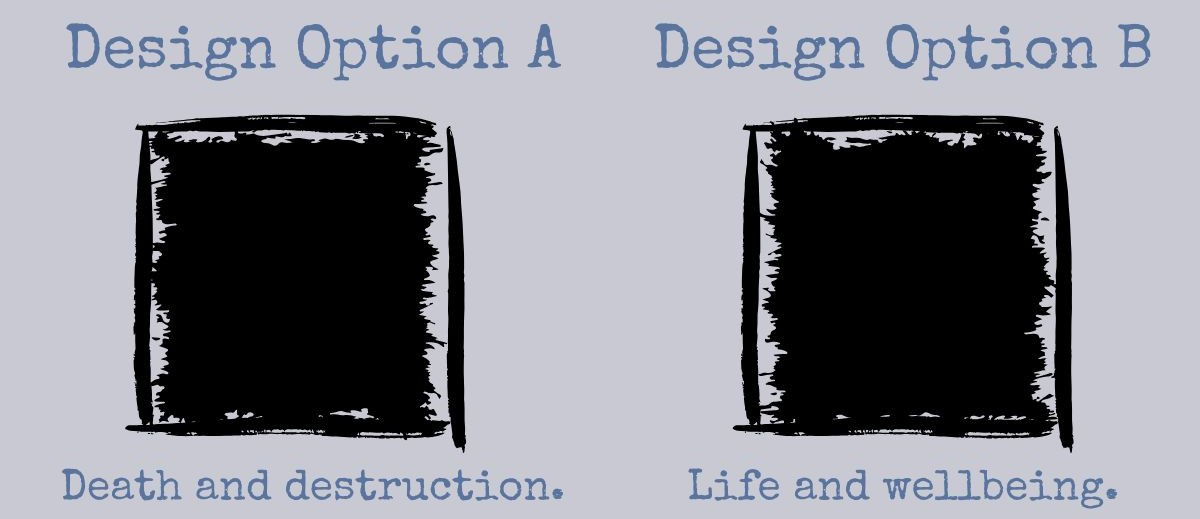
The engineering team presents two options to the community for designing an intersection, represented by two black boxes, labeled A and B.
Box A will dramatically increase the number of crashes, the number of people sent to the hospital, and the number of people sent to the morgue. (He had actual numbers, based on case studies.)
Box B will dramatically reduce the number of crashes, the number of people hurt, and the number of people killed.
Of course the community chooses Box B.
The black boxes are revealed: A is a traffic signal and B (the safety winner) is a roundabout.
The community revolts. “Box B can’t be safer because we don’t like roundabouts! We choose Box A.”
More than 20 years later, I still see the same emotional responses to land use and transportation topics. Some people have already established a belief that roundabouts (or any other objectively good thing) are bad, and no amount of raw data is going to win them over. But don’t completely write off the opposition. With the right emotional hooks, it’s possible to reset a person’s “thinking fast” mode. Then, the evidence (hundreds of roundabout case studies, for example) will be served up in their “thinking slow” mode. I’ve seen it happen with roundabouts, bike lanes, single-stair buildings, road diets, and speed cameras.
Before you write the next fact sheet, speak at the next public meeting, or post your next social media thread, ask questions like: What would make this feel right to someone who doesn’t already agree with me? What story, experience, or frame would give them reason to soften?
If you want to have any hope of persuading people, you’ve got to first understand how the human mind works.
I was just at public hearing about a new multifamily building right next to the commuter rail. The presenter tried to convince people that there didn't need to be more parking in the building than planned but she mentioned that the data she was presenting may not seem like commonsense but it's true. I agree her data was accurate
But after that virtually every speaker said it's just commonsense that there needs to be more parking. Everyone will have cars at least one if not more. You have to believe in commonsense. What was she thinking to not believe in commonsense... The data argument went nowhere with the neighbors.
Brilliant. I admit, that math word problem caught me. I knew the easy answer couldn’t be it so I had to dust off my very rusty (basic) algebra skills. Presenting choices as a black box is a great idea. 👏