

Picture yourself standing on the curb in front of your house. You’ve got your feet together, you rise onto your tiptoes, stretch both arms up over your head, and jump straight up and land back on the curb. Now imagine the same exercise on the edge of a 5-story roof. None of us would do it, even though we know we’re capable of jumping straight up and landing in the same spot. We’d all take a pass because the consequence of a minor slipup is death. The risk-to-reward ratio simply isn’t worth it.
Humans constantly perform risk compensation. We adjust behavior based on how safe we perceive an environment to be, often without realizing it.
Eating lobster — am I allergic to shellfish?
Singing in the rain — is anyone within earshot?
Swimming alone in the ocean — can I see the shore?
Riding a scooter in the street — is it a six-lane arterial or a quiet neighborhood block?
Driving a car at 60 mph — am I on a highway or a beach?
Not every decision is life-or-death, but the pattern holds: perceived safety changes behavior. Risk compensation gets complicated fast, because humans are wonderfully irrational. But we’re consistently willing to push the edges of “risky” when something (speed, convenience, comfort) makes the risk feel worth taking.
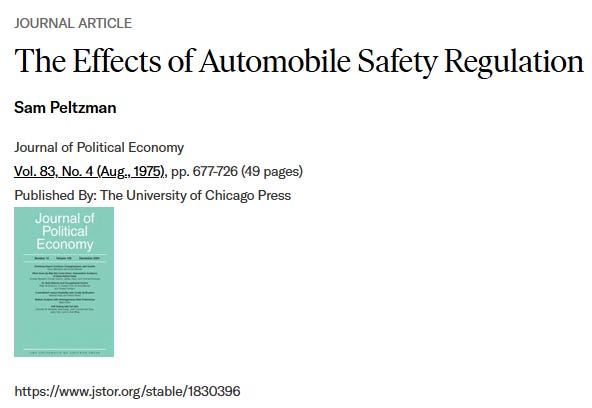
Sam Peltzman, an economist at the University of Chicago, published research in 1975, arguing that automobile safety regulations were largely offset by riskier driving behavior. In other words, as cars had more safety features, people’s driving behavior would get worse because “my car is safe.”
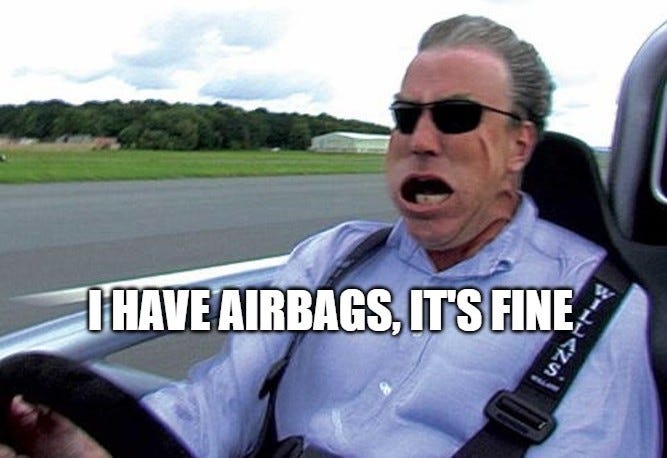
Why do Danish cyclists ride so casually through traffic? Because they aren’t riding along the edge of a rooftop the way American cyclists often are. Infrastructure is everything. The Peltzman Effect is a reminder that street design is linked to traffic safety outcomes because people respond to how safe a space feels.
Americans have been trained to expect hostile environments for biking, scootering, and skateboarding, and a remarkably pleasant environment inside a car. Comfortable seating, climate control, sound insulation. Driving feels so safe and frictionless that we compensate by doing things drivers a century ago wouldn’t dream of. Picture a man-on-the-street interview in 1922: “Good morning, sir, how often do you eat a freshly prepared meal while operating this jalopy? Never? What about trimming your beard?”
Peltzman was asking the questions every road safety advocate should ask:
Why aren’t traffic deaths sharply declining every year as cars get safer?
Does effortless steering encourage faster, less attentive driving?
Do better shock absorbers make speeding over rough pavement feel safer than it is?
Each of these “improvements” can quietly produce a new kind of danger that’s harder to see because everything feels fine. In his book Foolproof, Greg Ip said “People feel safe, and the feeling of safety allowed danger to reemerge, often hidden from view.”
It’s tempting to ask the government to demand car makers be required to install stronger glass, more airbags, backup cameras, and collision alerts because they all feel like safety improvements. Those tools do have benefits, but they aren’t making us better drivers.
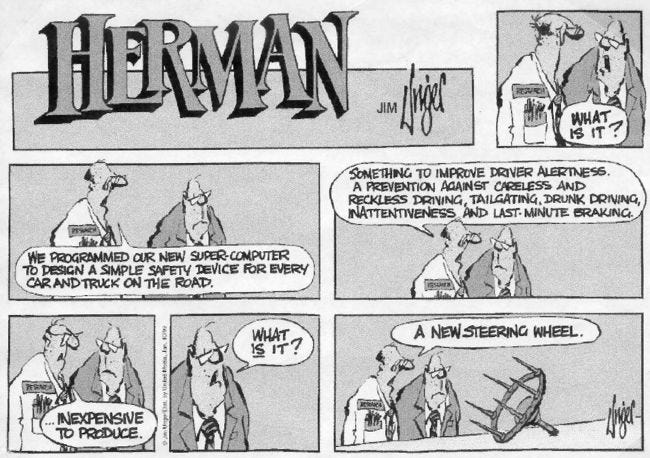
People are more careful when driving a car that feels a little dangerous. In the same way, a street that feels a little dangerous to speed on is a safer street. When you drive in an area with narrow lanes, parked cars close by, and people walking and riding bikes nearby, you naturally slow down and pay attention without being told to.
Just as our brains compensate for more safety features by taking more risk, they’ll compensate for perceived danger by guiding us to drive more carefully. Street design can adapt to human nature instead of fighting it. Make streets feel just risky enough to keep drivers on their best behavior, so that walking, biking, or rolling never feels like the riskier choice.
If this theory is correct, as you make streets safer for bicyclists and pedestrians, won’t they become less attentive and engage in more risky behavior?